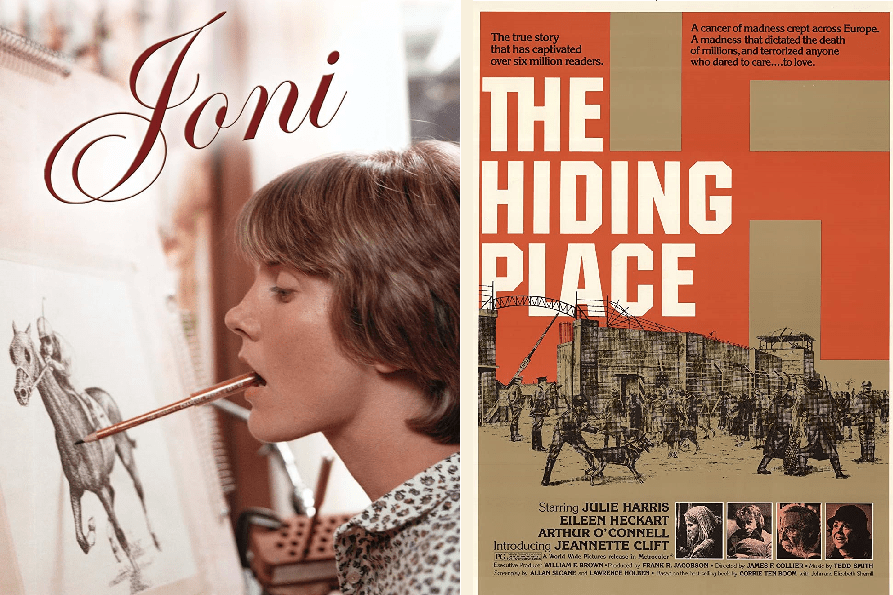
Duo #01: Billy Graham and James F. Collier
Sometime around the 1970s, Billy Graham started a film studio called World Wide Pictures. Billy Graham was an influential 20th century protestant evangelist who used stadiums and TV to preach the Christian message of salvation. You might know him from an episode of Netflix’s The Crown, where his conversation with The Queen was depicted (inaccurately, I’m told). The largest crowd ever at the MCG (Melbourne, Australia’s stadium that hosted Taylor Swift in 2024) was Billy Graham’s 1959 Christian meeting.
The best known films from his studio are two biographical movies – both directed by James F. Collier. The first was The Hiding Place (1975), about the Dutch Christian family who hid Jewish people in their home, which the Nazis found about. They subsequently sent the Ten Boom family to a Nazi concentration camp. The real Corrie Ten Boom, the main character of the story, shows up at the end of the film! (Interestingly, in 2023 another excellent version of The Hiding Place was released, this time a filmed stage play.)
Collier’s follow-up ‘Joni’ came in 1979, a film about a young athlete who became paralysed from the neck down. She suffered through doubts, anger and grief while dealing with her disability. It was based on Joni Eareckson Tada’s 1976 autobiography, and since she had drama experience in high school, she acted as herself.
This would have been a challenge. Not only to act while having a physical disability, but also to relive distressing moments from one’s life. Joni has reflected on this experience in her 1986 book Choices…Changes.
‘Joni’ is first and foremost a hopeful story about the comfort that Jesus can bring, as a light in the darkness of suffering. On that note, I suppose The Hiding Place is also about the light in the darkness of the concentration camp. It was of Ten Boom’s sister’s devout and determined faith, challenging her discouraged sister Corrie.
Both The Hiding Place and Joni are excellently directed. We can tell that The Hiding Place was shot on film because it looks very grainy at times, but that simply adds to the dreary character of a wintry 1940s Holland, and the dingy prison camp.
They both use the principle of Chekhov’s Gun very well – the idea of set-up and payoff. For example, if you see a gun on the wall at the start of the film, it should be taken down and used by the end. However, since I noticed this factor while watching the two films, I wonder if the direction was a bit like ‘Connect the Dots’ or ‘Paint by Number’ in method. But for me this element was enjoyable. (It is more noticeable in The Hiding Place, which makes sense, since Collier had more experience by the time he made ‘Joni’.) Both films take the audience on an emotional and intellectual journey.
How did this duo influence Christian cinema? Well, firstly it was Billy Graham’s recognition that movies are a great way of telling stories that can influence people for good. As he used the new mode of television to preach the gospel, he also took the opportunity to make movies to tell Christian stories. In fact, his evangelistic association’s film arm continued into the 21st century, with a small number of releases.
Mainstream filmmakers also know the power of movies and their influence. One commentator said that the change of our culture to accept gay marriage was strongly influenced by the Hollywood writers who wrote gay characters into films and TV in the 90s and onwards.
Of course, this duo is a bit patched together by myself, because it is simply that James F. Collier happened to direct these two popular Billy Graham films. But then again, I wonder if Collier actually influenced the way that evangelical protestant Christians would tell the stories of their own people.
Ten Boom was already a well-known church figure since WWII, having “Tramped” around the world preaching forgiveness. Joni’s book was also very popular, I believe. (Her ministry has continued to this day and she captivatingly points people to Jesus.) Their autobiographies, telling true stories of sacrifice and courage in the context of faith, made for compelling movies. Collier’s approach has been done again and again over the decades.
So, now we have a formula, or a subgenre of modern Christian films, which I’m calling “The Testimony Movie”. (The 1970 film The Cross and the Switchblade, about a Christian ministry to gangs in New York City was possibly the first one. This writer is not too familiar with it, given he saw it only once as a child.) The Case For Christ (about Lee Strobel) and On Wings of Eagles (about olympian Eric Liddell) are two more examples.
Here is the formula for a Testimony Movie: A Christian or well-known believer writes a book – or maybe tells their story publicly at events like concerts or church services. (These days it could include social media.) Then the film is made. The protagonist might make an appearance in the film. There are different versions of this: acting in the movie, appearing in the last scene, or merely featured in archival footage and family photos at the end, with “Where Are They Now”-type updates.
The protagonists or their family will help promote the movie – doing interviews and/or events. This has never been more prevalent than with For King and Country’s Unsung Hero movie which released recently. (The Smallbone family has been inescapable in Christian media this month.)
This formula has stood the test of time, and also spawned a sub-sub-genre “The Christian Music Artist’s Testimony Movie”, which I will talk about in one of my next articles on the duos that changed Christian movies.
WHERE ARE THEY NOW
The Billy Graham Evangelistic Association has uploaded both of these movies to Youtube to watch for free.
The movie ‘Joni’ has been watched 354,000 times on Youtube since being uploaded about a year ago. Joni is still speaking publicly about God’s grace through suffering, and eternal hope for the afterlife through Jesus’ work on the cross. Joni is also an Oscar-nominated vocalist.
The Hiding Place has been viewed 1,700,000 times on Youtube since 2 years ago.
This year a graphic novel of The Hiding Place is being released. There is also a picture book available of Corrie’s story, aimed at inspiring young girls.
They may be little known in some circles, but these historical stories influenced not only the Christian Movie landscape, but thousands of lives too.
 Jonathan Paper
2 responses to “‘Joni’ and ‘The Hiding Place’: Duos That Defined Christian Movies #01”
[…] and heart. If you are someone who hates cheesy movies, don’t watch LIFEMARK. But if you want a true story that touches on the heartstrings, with a focus on the power of Family, and adoption after teen pregnancy – then this movie is […]
LikeLike
[…] stopped making their epic Bible films (The Ten Commandments, The Robe, Ben Hur). Then in the 70s, Christians began making their own films.Some are shockingly awful. As a teen, I watched the 1973 film Thief in the Night – a thriller […]
LikeLike